

Burgundy Truffle
Tuber aestivum
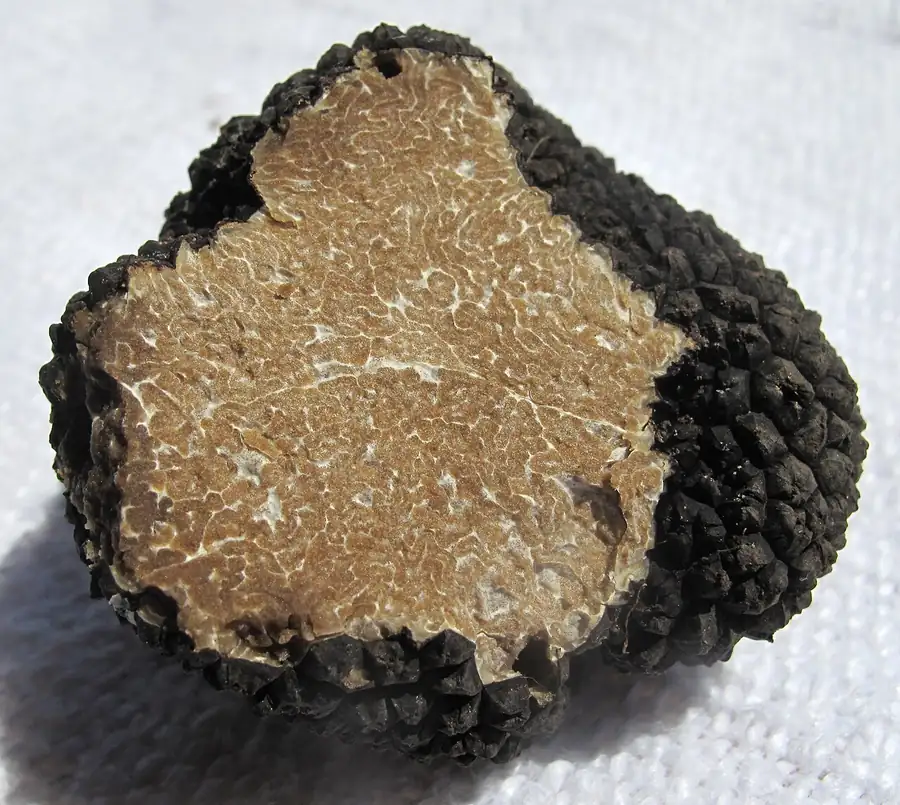
The Burgundy truffle is farmed in orchards of mycorrhizal trees, not in bags: expect six to ten years before the first truffles and a soil pH above 7.
Tuber aestivum, also called the summer truffle, is an ectomycorrhizal fungus that partners with the roots of host trees. The University of Missouri Center for Agroforestry describes orchards in which mycorrhizal seedlings, mainly hazelnut and oaks, are planted into well-drained soil with a pH above 7.0. Production commonly lags planting by six to ten years, and full production may take until the orchard is 12–15 years old, often when shade and a litter layer have formed.
Cultivation facts
Taxonomy & ecology
| Scientific name | Tuber aestivum |
|---|---|
| Also known as | Summer truffle, Tuber uncinatum |
| Synonyms | Tuber uncinatum |
| Family | Tuberaceae |
| Order | Pezizales |
| Genus | Tuber |
| Lifestyle | Mycorrhizal |
| Natural habitat | Roots of host trees, especially hazel and oaks, in well-drained soil with a pH above 7.0 |
| Wood hosts | Common hazelnut, Turkish hazelnut, Sessile oak, Pubescent oak, Common oak, European hornbeam, Hop hornbeam, Atlas cedar, Austrian black pine |
| Cultivation status | Not cultivable on prepared substrate |
Growing notes
The Burgundy truffle is generally considered more aggressive than the Périgord truffle in competing with native mycorrhizal fungi, and it is recommended in the guide for Missouri because it tolerates soil that freezes in winter better than the Périgord. Hazelnut (Corylus avellana) is very productive but welcomes many competing fungi, while seed sources of common oak vary in cold hardiness and tolerance of high-pH soil. Truffles form completely below ground, so harvesting needs a well-trained dog. The guide itself warns that if you make an error you may not know it for ten years. This page covers cultivation only and cannot help identify wild mushrooms or tell you whether a mushroom is safe to eat.
Questions about growing Burgundy Truffle
Can I grow Burgundy truffles at home?
Not in a bag or kit. They are grown in orchards of inoculated host trees, and the first truffles take six to ten years to appear.
What soil does the Burgundy truffle need?
A pH above 7.0 for fruiting, with moderate clay and organic matter, and well-aerated, freely draining soil, according to the University of Missouri guide.
Which trees are used?
Common hazelnut and oaks are the main hosts; the guide also lists European hornbeam, hop hornbeam, Atlas cedar and Austrian black pine.
How are truffles harvested?
They form completely below the soil surface, so a trained dog is needed to find them as they mature.
How is it different from the Périgord truffle?
The guide says the Burgundy truffle takes about eight years to produce compared with about five for the Périgord, tolerates soil that freezes better and sells for roughly half the price.