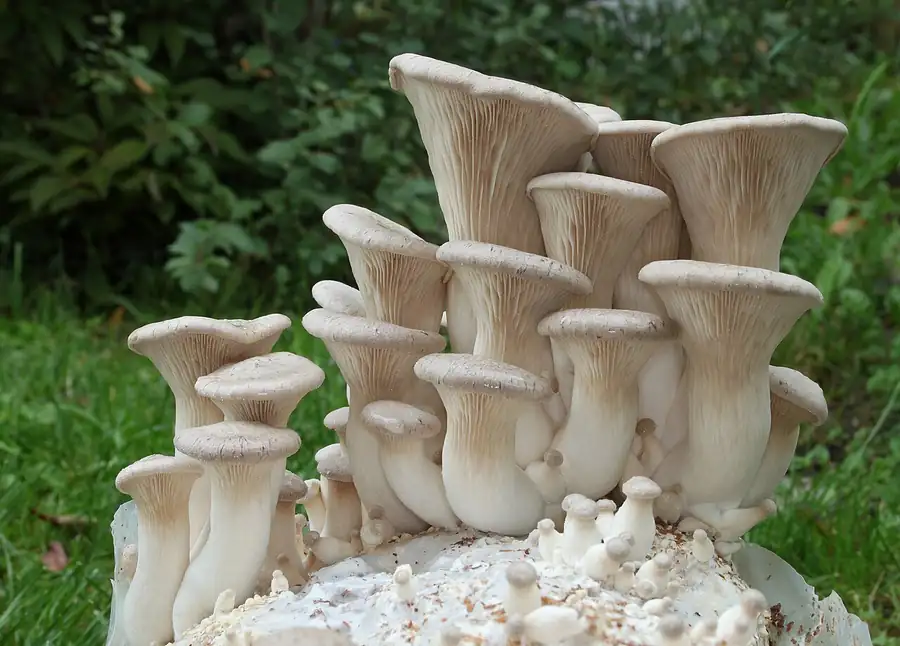
King oyster is the thick-stemmed, meaty cousin of the common oysters, prized for its texture and shelf life. It is a step up in difficulty because it needs cool temperatures to pin well.
Pleurotus eryngii colonizes on hardwood sawdust in 12–18 days at 20–22 °C with humidity of 85–95%. For fruiting, it wants 15–18 °C and 80–95% humidity, with medium fresh-air exchange and low indirect light. The key detail is pinning: aim for about 15 °C with 95–100% humidity to start the pins, after which the temperature can be raised toward the incubation range. Pins take 5–8 days to form and the fruit matures in 7–10 more.
Fruiting temp
15–18 °C
Fruiting humidity
80–95%
Colonization
12–18 d
Bio. efficiency
40–77%
Cultivation parameters
Climate
Colonization temperature
20–22 °C
Fruiting temperature
15–18 °C
Incubation humidity
85–95%
Fruiting humidity
80–95%
Fresh-air exchange
Medium
Light
Low indirect
Air / CO₂ notes
Pin at ~15 °C with 95–100% humidity, then temperature can be raised toward incubation range.
Cold shock
Not required
Timing & substrate
Colonization
12–18 days
Pinning
5–8 days
Maturation (pin to harvest)
7–10 days
Flush interval
16–21 days
Primary substrate
Hardwood sawdust
Substrate options
Hardwood sawdust
Substrate compatibility
Substrate
Suitability
Notes
Safflower hay
Good
Reported biological efficiency 73.1%
Cotton waste
Good
Reported biological efficiency 71.56%
Phaseolus stems
Good
Reported biological efficiency 67%
Oak sawdust
Good
Reported biological efficiency 66.6%
Corn cobs
Possible
Reported biological efficiency 51.8%
Wheat straw
Possible
Reported biological efficiency 38.41–87.5% across 3 studies
Sunflower head residue
Possible
Reported biological efficiency 46.8%
Rice straw
Possible
Reported biological efficiency 45.99%
Yield
Biological efficiency
Typical range 40–77%
Flushes
2 (roughly 70% / 30% of total)
Yield notes
Hardwood sawdust outperforms straw on texture and shelf life.
Practical literature-range
Best methods
Grow bags, Sawdust blocks, Climate chamber
Watch for
Green Mold (Trichoderma), Bacterial Blotch (Pseudomonas), Long Stems, Small Caps (high CO2), Aborted Pins
Difficulty
Intermediate — Needs cool pinning temperatures to fruit well
Taxonomy & ecology
Scientific name
Pleurotus eryngii
Growing notes
Hardwood sawdust outperforms straw on texture and shelf life, so it is the substrate of choice. Expect a strong first flush — about 70% of the total — followed by a second of about 30%, 16–21 days later, within a planning band of about 40–77% biological efficiency (reported straw and sawdust results, median 47%). Grow bags, sawdust blocks and a climate chamber are the best setups, because holding a cool, humid pinning window is easier in a controlled space. Green mold, bacterial blotch, CO₂ legginess and aborted pins are the issues to watch for.