

Golden Oyster
Pleurotus citrinopileatus
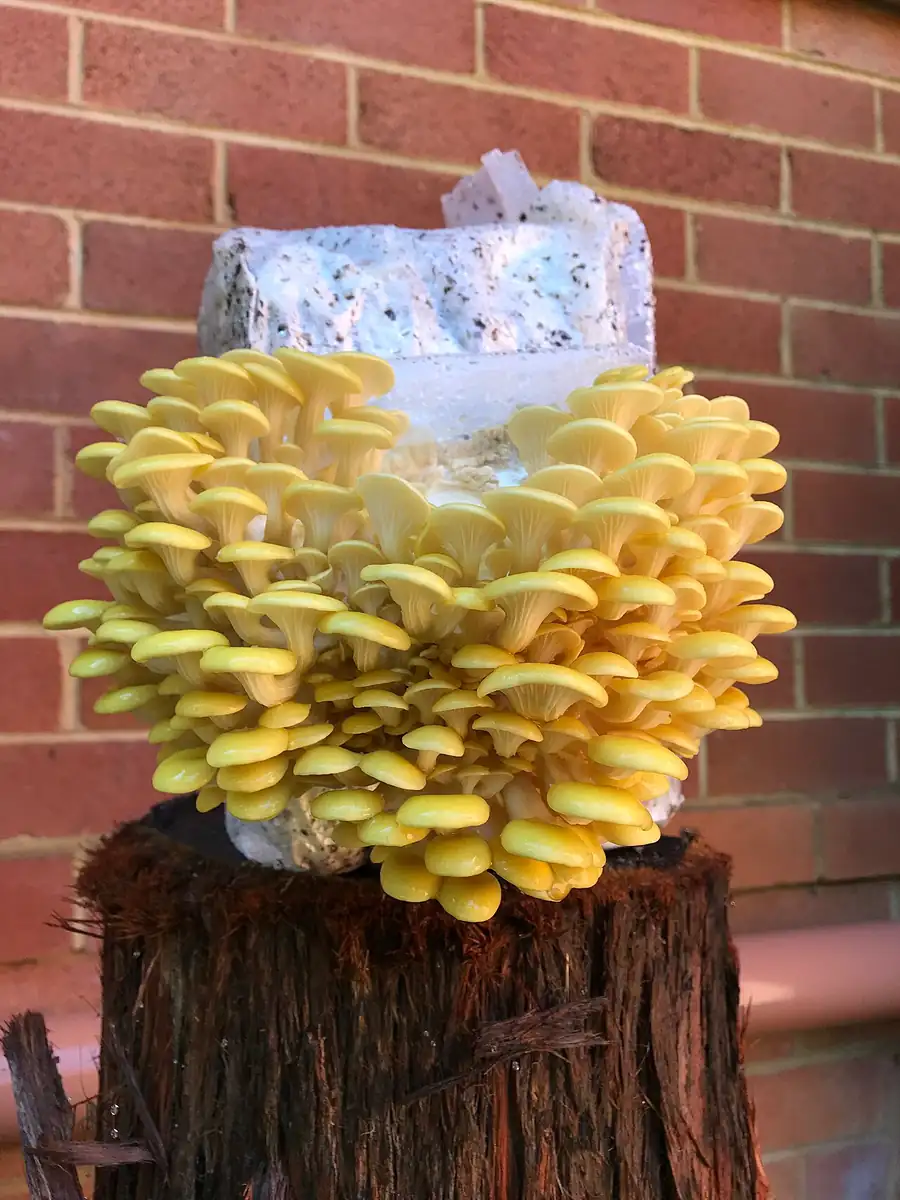
The golden oyster is the bright yellow oyster mushroom, called tamogitake in Japan. It is easy to grow, but it comes with an ecological caveat: outside its native range it behaves as an invasive species.
Pleurotus citrinopileatus is native to eastern Russia, northern China and Japan. It is cultivated commercially on grain, straw or sawdust, and grape and olive pomace work as alternative substrates. In bag culture in Thailand the FAO manual lists a cultivation temperature interval of 24–34 °C. A compiled review reports biological efficiency of about 90% on paddy straw and 91–94% on paddy straw mixed with cauliflower leaves, brassica straw or pea pods, compared with 74% on oak sawdust and 68.5% on wheat straw.
Cultivation parameters
Climate
| Overall cultivation temperature | 24–34 °C |
|---|
Timing & substrate
| Primary substrate | Straw or sawdust |
|---|---|
| Substrate options | Paddy straw, Wheat straw, Oak sawdust, Grape and olive pomace (alternative) |
Substrate compatibility
| Substrate | Suitability | Notes |
|---|---|---|
| Paddy straw + pea pods | Best | Reported biological efficiency 94.3% |
| Paddy straw + brassica straw | Best | Reported biological efficiency 92.3% |
| Paddy straw + cauliflower leaves | Best | Reported biological efficiency 90.8% |
| Paddy straw | Best | Reported biological efficiency 90% |
| Oak sawdust | Good | Reported biological efficiency 73.9% |
| Wheat straw | Good | Reported biological efficiency 68.52% |
| Sunflower head residue | Possible | Reported biological efficiency 54.1% |
| Phaseolus stems | Poor | Reported biological efficiency 43% |
Yield
| Biological efficiency | Typical range 78–93% |
|---|
Practical literature-range
| Best methods | Bags of straw or sawdust |
|---|---|
| Difficulty | Beginner — Grows on grain, straw and sawdust like other oysters; consider the invasive-species note below |
Taxonomy & ecology
| Scientific name | Pleurotus citrinopileatus |
|---|---|
| Also known as | Yellow oyster, Tamogitake |
| Synonyms | Pleurotus cornucopiae subsp. citrinopileatus |
| Family | Pleurotaceae |
| Order | Agaricales |
| Genus | Pleurotus |
| Lifestyle | Saprotroph |
| Natural habitat | Dead wood |
| Native range | Eastern Russia, northern China and Japan; now also found in the wild in parts of North America, Europe, Asia and Africa outside its native range |
| Cultivation status | Commercially cultivated |
How to grow Golden Oyster, step by step
- Choose a substrate. Paddy straw, alone or mixed with vegetable residues, performed best in the reported results; sawdust and wheat straw also work.
- Prepare and spawn. Pasteurise the substrate and mix in grain spawn under clean conditions.
- Incubate warm. Hold the bags in the 24–34 °C range reported for this species until fully colonised.
- Fruit and harvest. Provide fresh air, humidity and light, and harvest the clusters as they mature.
- Dispose responsibly. Bag or compost spent substrate so that it cannot spread spores or mycelium into local woodland.
Growing notes
Paddy straw (alone or mixed with vegetable residues) was clearly the best substrate in the reported results, while safflower hay and bean stems gave only about 43%. Please read the safety note: in its introduced range the golden oyster appears to displace native fungal communities, and cultivation outside its native range has been implicated as a major source. If you can, grow a locally native oyster species instead, and never release spent substrate or fruit bodies into the wild.
Safety notes
- Golden oyster is invasive outside its native range: a 2025 study found it appears to displace native fungal communities, and cultivation outside that range is implicated as a major source. Use local oyster varieties where possible and do not discard spent substrate or fruit bodies into the wild.
Questions about growing Golden Oyster
Where is the golden oyster native?
Eastern Russia, northern China and Japan. It has also been found in the wild in parts of North America, Europe, Asia and Africa outside that range.
Is it a problem to grow golden oysters outside their native range?
It can be. A 2025 study found that in its introduced range the golden oyster appears to displace native fungal communities, and cultivation is implicated as a major source. Growers are advised to use local oyster varieties and to keep spent substrate out of the wild.
What temperature does it need?
The FAO manual gives a cultivation interval of 24–34 °C for yellow oyster in bag culture in Thailand.
Which substrate gave the best yield?
In a compiled review, paddy straw reached about 90% biological efficiency and paddy straw mixtures 91–94%, ahead of oak sawdust at 74% and wheat straw at 68.5%.