

Pink Oyster
Pleurotus djamor
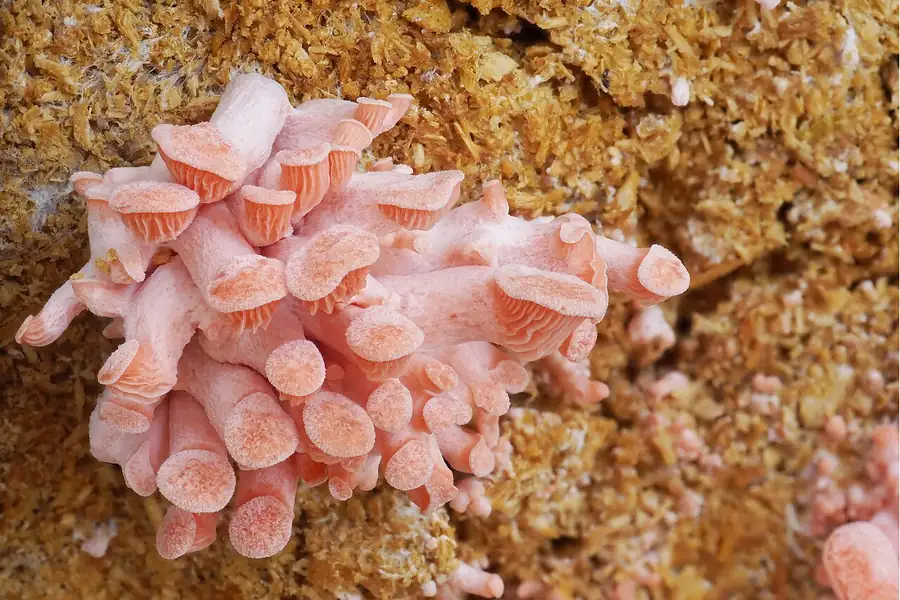
The pink oyster is the tropical member of the oyster family: it grows on fallen coconuts and palm fronds in the wild and does best warm, at around 25–30 °C.
Pleurotus djamor occurs in tropical and subtropical regions, reaching as far north as Japan and as far south as New Zealand, and in Hawaii it is often found on fallen coconuts and the stalks of palm fronds. It can be cultivated at relatively warm temperatures of 25–30 °C on barley straw, wheat straw, sawdust and even tea leaves. Reported biological efficiency in a compiled review was 62.5% on oak sawdust, 77% on paddy straw and 68.7–75.5% on wheat straw, with the highest efficiency at a 5% spawn rate in a trial of 1–5%.
Cultivation parameters
Climate
| Overall cultivation temperature | ~25–30 °C |
|---|
Timing & substrate
| Primary substrate | Straw or sawdust |
|---|---|
| Substrate options | Barley straw, Wheat straw, Paddy straw, Sawdust, Tea leaves |
Substrate compatibility
| Substrate | Suitability | Notes |
|---|---|---|
| Phaseolus stems | Good | Reported biological efficiency 78.2% |
| Safflower hay | Good | Reported biological efficiency 77.8% |
| Paddy straw | Good | Reported biological efficiency 77% |
| Wheat straw | Good | Reported biological efficiency 68.68–75.5% across 2 studies |
| Oak sawdust | Possible | Reported biological efficiency 62.5% |
| Apple leaves | Possible | Reported biological efficiency 46.21% |
| Poplar leaves | Possible | Reported biological efficiency 45.56% |
| Sunflower head residue | Possible | Reported biological efficiency 45.5% |
Spawn & substrate preparation
| Spawn types | Grain spawn |
|---|---|
| Spawn rate | 1–5% of substrate weight |
| Spawn notes | In a spawn-rate trial the highest biological efficiency came at 5% spawn (rates of 1–5% were tested). |
Yield
| Biological efficiency | Typical range 67–77% |
|---|
Practical literature-range
| Best methods | Bags of straw or sawdust in a warm room |
|---|---|
| Difficulty | Beginner — Grows on a wide range of residues but prefers warm conditions |
Taxonomy & ecology
| Scientific name | Pleurotus djamor |
|---|---|
| Also known as | Flamingo oyster |
| Family | Pleurotaceae |
| Order | Agaricales |
| Genus | Pleurotus |
| Lifestyle | Saprotroph |
| Natural habitat | Fallen coconuts and the stalks of palm fronds in Hawaii; decaying plant material in the tropics |
| Native range | Tropical and subtropical regions, reaching Japan in the north and New Zealand in the south |
| Cultivation status | Commercially cultivated |
How to grow Pink Oyster, step by step
- Choose a substrate. Straw (wheat, barley or paddy) or sawdust, prepared and pasteurised.
- Add spawn. Use grain spawn; up to about 5% of the substrate weight was best in the cited trial.
- Keep it warm. Hold the bags in the warm 25–30 °C range reported for this species while the mycelium colonises.
- Fruit and harvest. Provide fresh air, humidity and light once colonised and pick the clusters as they mature.
Growing notes
Warm conditions are the main difference from pearl and blue oysters, which fruit cooler. The substrate ratings on this page come from reported biological efficiency: stems of common beans (Phaseolus), safflower hay, paddy straw and wheat straw all gave about 68–78%, while leaf litter such as apple, poplar and chinar leaves gave much less. Because only limited fruiting-room data was found, check humidity and fresh-air needs against the pearl oyster page and your strain.
Questions about growing Pink Oyster
What temperature does the pink oyster need?
It can be grown at relatively warm temperatures of 25–30 °C, which suits tropical and subtropical climates.
What substrate does the pink oyster grow on?
Barley straw, wheat straw, paddy straw, sawdust and tea leaves are all reported. In a compiled review, biological efficiency was about 68–78% on straw and bean stems and 62.5% on oak sawdust.
How much spawn does it need?
In a trial comparing 1–5% spawn, the fastest spawn run and the highest biological efficiency came at 5%.
Where does the pink oyster grow in the wild?
In tropical and subtropical areas, as far north as Japan and as far south as New Zealand, for example on fallen coconuts and palm fronds in Hawaii.