

Pearl / Grey Oyster
Pleurotus ostreatus
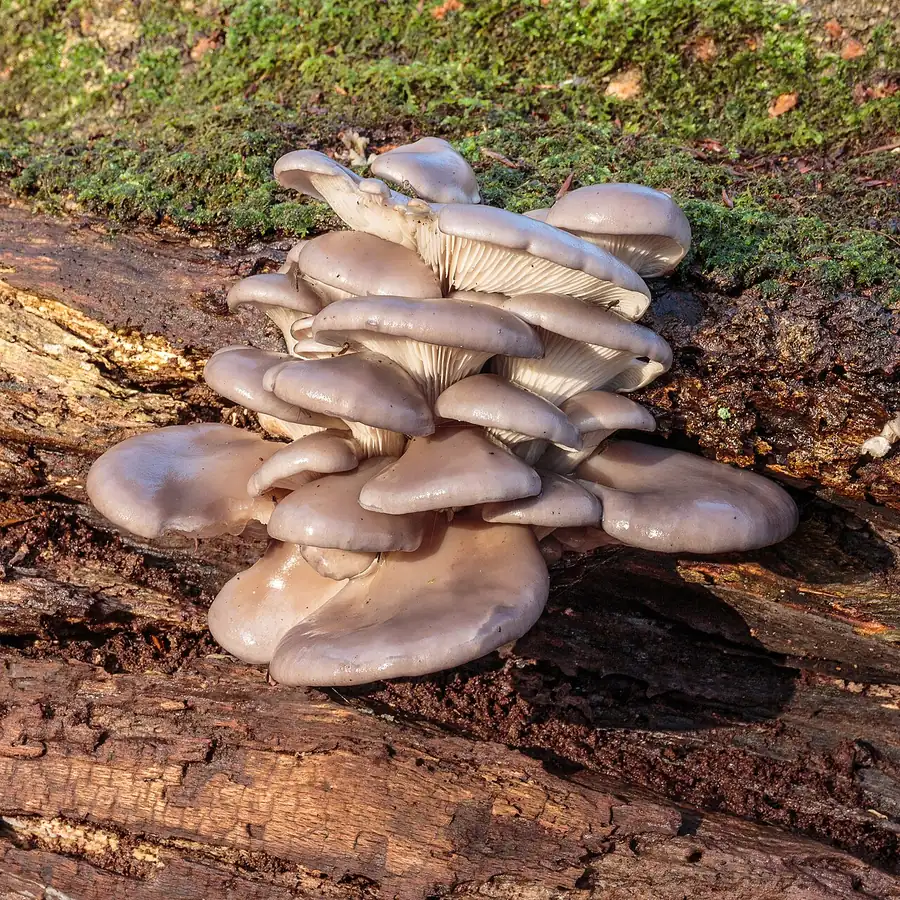
The pearl or grey oyster is the mushroom most growers start with, and for good reason: it colonizes fast, fruits on cheap pasteurised straw, and forgives the mistakes a first grow is bound to make.
It's a vigorous, high-yielding culinary species that fruits in shelving clusters of soft grey-brown caps. Mycelium runs through straw in a week or two, and once it's exposed to fresh air and light it pins readily. Expect three flushes from a well-run bag, with the first the largest. The main thing to get right is humidity and airflow during fruiting — oysters release a lot of spores and want plenty of fresh air, so a fruiting space that's both humid and well-ventilated pays off.
Cultivation parameters
Climate
| Colonization temperature | 22–24 °C |
|---|---|
| Overall cultivation temperature | 24–35 °C |
| Fruiting temperature | 13–18 °C (tolerant to ~24 °C) |
| Incubation humidity | ~70% |
| Fruiting humidity | 85–95% |
| Fresh-air exchange | High |
| Light | Bright indirect (needed to trigger pins) |
| Air / CO₂ notes | Fresh air and light needed to trigger primordia. |
| Cold shock | Not required (optional, strain-dependent) |
Timing & substrate
| Colonization | ~10–14 days |
|---|---|
| Pinning | 3–5 days |
| Maturation (pin to harvest) | 4–7 days |
| Flush interval | 12–16 days |
| Primary substrate | Pasteurised straw |
| Substrate options | Pasteurised straw, Sawdust |
Substrate compatibility
| Substrate | Suitability | Notes |
|---|---|---|
| Rice straw | Best | Reported biological efficiency 95.46% |
| Rice straw + wheat straw | Good | Reported biological efficiency 77.32% |
| Rice straw + paper | Good | Reported biological efficiency 74.89% |
| Cotton seed | Good | Reported biological efficiency 74.17% |
| Wheat straw + cardboard waste | Good | Reported biological efficiency 70.45% |
| Sugarcane bagasse | Good | Reported biological efficiency 67.04% |
| Sinar straw | Good | Reported biological efficiency 66.2% |
| Barley straw | Good | Reported biological efficiency 65.82% |
Yield
| Biological efficiency | Typical range 52–76% |
|---|---|
| Flushes | 3 (roughly 50% / 30% / 20% of total) |
| Harvest notes | Mist 2–3 times per day during fruiting. |
Practical literature-range
| Best methods | Grow bags, Straw beds, Monotub |
|---|---|
| Watch for | Green Mold (Trichoderma), Cobweb Mold (Dactylium), Bacterial Blotch (Pseudomonas), Long Stems, Small Caps (high CO2), Aborted Pins |
| Difficulty | Beginner — Fastest and most forgiving pilot species |
Taxonomy & ecology
| Scientific name | Pleurotus ostreatus |
|---|---|
| Also known as | Grey Oyster |
| Family | Pleurotaceae |
| Order | Agaricales |
| Genus | Pleurotus |
| Lifestyle | Saprotroph |
| Natural habitat | Dying and dead hardwood trees; a white-rot wood decomposer that also feeds on nematodes for nitrogen |
| Native range | Temperate and subtropical forests worldwide; absent from the Pacific Northwest of North America, where related species replace it |
| Wood hosts | Hardwoods |
| Cultivation status | Commercially cultivated |
How to grow Pearl / Grey Oyster, step by step
- Prepare the substrate. Choose straw, hardwood sawdust or an agricultural residue, soak it and drain it to field capacity.
- Pasteurise it. Heat-treat the damp substrate, for example in hot water at 70–80 °C for about 30 minutes as in the trial cited below, then let it drain and cool.
- Add the spawn. Mix grain spawn through the cooled substrate and pack it into bags, keeping the work clean.
- Incubate. Keep the bags at a steady warm temperature, around 22–25 °C, until the substrate is fully white; this took 13–18 days in the cited trial.
- Fruit. Cut openings, give fresh air, indirect light and high humidity; keep the fruiting space within your strain's temperature range.
- Harvest. Pick the cluster before the caps flatten completely and expect further flushes at roughly two-week intervals.
Growing notes
Straw is the cheapest route in: pasteurise it (hold at roughly 65–80 °C for an hour or so), drain to field capacity, mix in grain spawn, and bag it. Colonization is quick at room temperature; once the substrate is white, cut fruiting holes and move it somewhere humid with good airflow and indirect light. Pins appear within days. Because oysters fruit so readily and release heavy spore loads, ventilation matters as much as humidity — stagnant, over-wet air invites bacterial blotch and long, leggy stems with small caps (a sign of too much CO₂). Harvest the cluster just before the caps flatten fully.
Questions about growing Pearl / Grey Oyster
How long does it take from inoculation to the first oyster mushrooms?
In a peer-reviewed trial at about 25 °C, mycelium colonized the bags in 13–18 days, primordia appeared 20–27 days after the start of incubation, and the first harvest came 23–30 days after incubation began. Strain, substrate and temperature shift these numbers, so treat them as a guide.
What temperature and humidity do oyster mushrooms need?
Our database lists colonization at 22–24 °C and fruiting at 13–18 °C with 85–95% humidity for temperate strains. Tropical bag cultivation guides work warmer: the FAO training manual gives 24–35 °C for white oyster strains and 75–90% humidity in the fruiting house. Check which type your spawn is.
What substrate works for oyster mushrooms?
Pasteurised straw and hardwood sawdust are the usual choices, and agricultural residues also work. The FAO manual's reference sawdust bag is 100 kg sawdust with 5 kg rice bran, 2 kg calcium sulfate, 1 kg calcium carbonate, 0.2 kg magnesium sulfate and 0–1 kg sugar, which you can adjust.
Do oyster mushrooms grow in the wild?
Yes. Pleurotus ostreatus is widespread in temperate and subtropical forests around the world, where it grows on dying and dead hardwood trees as a wood decomposer. It is absent from the Pacific Northwest of North America, where related species such as P. pulmonarius take its place.
How much can a bag yield?
A practical figure from the FAO manual is 250–500 g of mushrooms per substrate bag, depending on the species. Biological efficiency (fresh weight as a share of dry substrate) varies strongly with the material: one trial measured up to about 238% on its best residue, while our planning band for pearl oyster, taken from reported straw and sawdust results, is about 52–76% with a median near 66%.