

Black Truffle
Tuber melanosporum
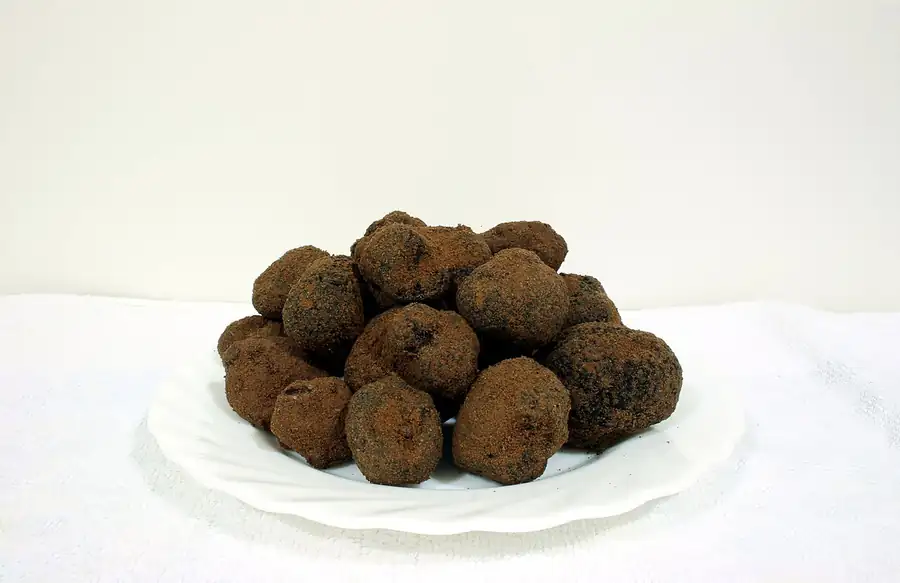
You cannot grow black truffles on a bag of substrate. They live on the roots of host trees, so cultivation means planting trees that have been inoculated with the fungus and waiting for years.
Tuber melanosporum is an ectomycorrhizal fungus: it wraps tree roots and trades water and nutrients for sugars from the tree, and it cannot break down cellulose or lignin itself. That is why the usual mushroom methods, a bag of straw or sawdust, do not work. A 2021 review describes five steps to farm it: producing mycorrhizal seedlings, letting them develop and acclimate in a nursery, planting them out, waiting for the first truffles, and running a performing tree orchard. The first controlled cultivation took place in 1977, when truffles were harvested from 4.5-year-old hazel seedlings that had been planted out.
Cultivation facts
Taxonomy & ecology
| Scientific name | Tuber melanosporum |
|---|---|
| Also known as | Périgord black truffle |
| Family | Tuberaceae |
| Order | Pezizales |
| Genus | Tuber |
| Lifestyle | Mycorrhizal |
| Natural habitat | Roots of host trees such as oaks and hazel |
| Cultivation status | Not cultivable on prepared substrate |
Growing notes
Orchards, called truffières in French, now supply up to 90% of the black truffles produced in Europe, and all of the truffles in Australia, New Zealand, Chile and South Africa. The review says that truffle cultivation is very recent in human history and that more research is needed to improve yields and profitability, so this is a long-term agricultural project, not a home hobby. If you are interested, start by finding a nursery that sells certified mycorrhizal seedlings and ask an agronomist about suitable soils and climate. This page covers cultivation only and cannot help identify wild mushrooms or tell you whether a mushroom is safe to eat. The University of Missouri Center for Agroforestry guide adds that the Périgord black truffle typically starts producing about five years after planting, compared with about eight years for the Burgundy truffle, and that it is less tolerant than the Burgundy truffle of soil that freezes in winter. Truffles form below the soil surface, so harvesting needs a trained dog. A well-run orchard can yield tens of pounds per acre for years, but an error may not show for ten years, so get advice before you plant.
Questions about growing Black Truffle
Can I grow black truffles at home?
Not on a kit or in a bag. Truffles need a host tree with mycorrhizal roots and an orchard that takes years to start producing.
Why can't truffles grow on substrate?
They are mycorrhizal: they depend on a living tree for sugars and cannot digest cellulose or lignin themselves.
Are truffles really farmed?
Yes. Up to 90% of black truffles produced in Europe come from truffle orchards, and in the southern hemisphere all of them do.
How long does it take?
The first controlled harvest, in 1977, came from hazel seedlings that were 4.5 years old; plan on several years before the first truffles.
Where can I find a mycorrhizal seedling?
Specialist tree nurseries sell seedlings inoculated with truffle fungus; ask an agronomist for suitable soil and climate before buying.
How long until a truffle orchard produces?
For the Périgord black truffle about five years after planting, according to the University of Missouri Center for Agroforestry; the Burgundy truffle takes about eight, and full production can take 12–15 years.