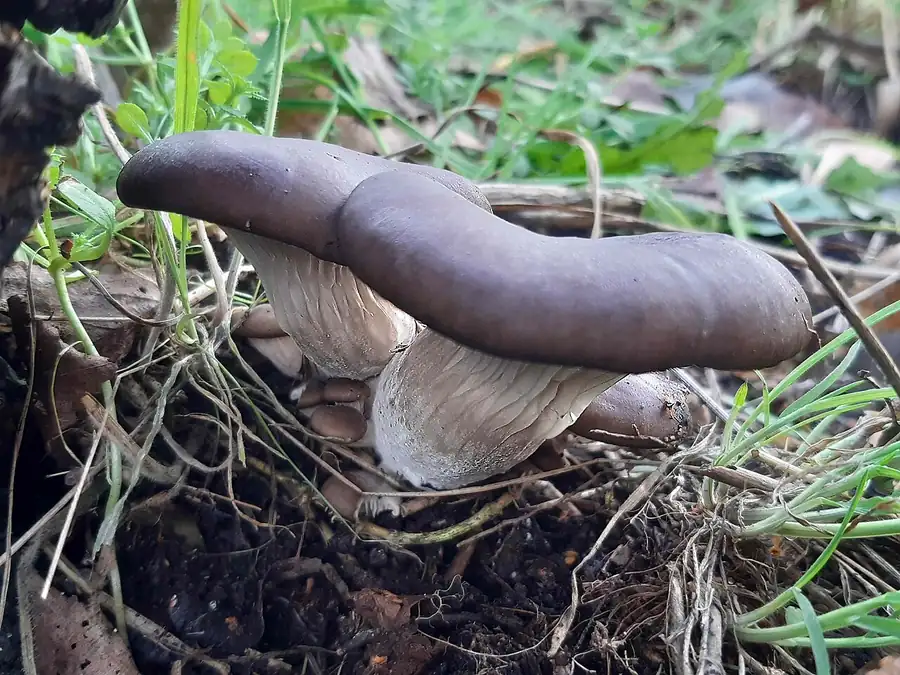
Blue oyster is a close relative of the pearl oyster and just as beginner-friendly, with the same quick colonization and the same appetite for pasteurised straw, but it likes its fruiting room on the cooler side.
Grown as a variety of Pleurotus ostreatus, blue oyster follows nearly the same schedule as pearl: roughly two weeks to colonize at 22–24 °C, pins within three to five days of fruiting conditions, and a harvest four to seven days after that. It fruits in the 13–18 °C range at 85–95% humidity and wants plenty of fresh air and bright indirect light to trigger primordia. A well-run bag gives about three flushes, weighted roughly 50% / 30% / 20%, so the first harvest is the one that matters most.
Fruiting temp
13–18 °C
Fruiting humidity
85–95%
Colonization
10–14 d
Bio. efficiency
52–76%
Cultivation parameters
Climate
Colonization temperature
22–24 °C
Fruiting temperature
13–18 °C
Incubation humidity
~70%
Fruiting humidity
85–95%
Fresh-air exchange
High
Light
Bright indirect (needed to trigger pins)
Air / CO₂ notes
Fresh air and light needed to trigger primordia.
Cold shock
Not required (optional, strain-dependent)
Timing & substrate
Colonization
~10–14 days
Pinning
3–5 days
Maturation (pin to harvest)
4–7 days
Flush interval
12–16 days
Primary substrate
Pasteurised straw
Substrate options
Pasteurised straw, Sawdust
Substrate compatibility
Substrate
Suitability
Notes
Rice straw
Best
Reported biological efficiency 95.46%
Rice straw + wheat straw
Good
Reported biological efficiency 77.32%
Rice straw + paper
Good
Reported biological efficiency 74.89%
Cotton seed
Good
Reported biological efficiency 74.17%
Wheat straw + cardboard waste
Good
Reported biological efficiency 70.45%
Sugarcane bagasse
Good
Reported biological efficiency 67.04%
Sinar straw
Good
Reported biological efficiency 66.2%
Barley straw
Good
Reported biological efficiency 65.82%
Yield
Biological efficiency
Typical range 52–76%
Flushes
3 (roughly 50% / 30% / 20% of total)
Practical literature-range
Best methods
Grow bags, Straw beds, Monotub
Watch for
Green Mold (Trichoderma), Cobweb Mold (Dactylium), Bacterial Blotch (Pseudomonas), Long Stems, Small Caps (high CO2), Aborted Pins
Difficulty
Beginner — Likes cooler fruiting temperatures than pearl
Taxonomy & ecology
Scientific name
Pleurotus ostreatus var. columbinus
Growing notes
Treat it as you would pearl oyster: pasteurise straw, drain it to field capacity, mix in grain spawn and bag it. Keep the colonization room around 22–24 °C, then move the bag to a cooler, humid space for fruiting — that cooler window is the main difference from pearl, so check your fruiting room temperature before you commit a whole batch. Like all oysters, it does best with good air exchange; stale, over-wet air tends to produce leggy stems and bacterial blotch. Expect about 12–16 days between flushes, and verify the numbers against your own strain, since these are literature ranges.